XURRENT
Designed to Stand out. Built to Convert.
Reimagining Xurrent’s website as both a more distinctive expression of the brand and a true growth engine.
Role: Founder & Marketing Consultant, Argentum & Co.
Scope: Brand Strategy • Digital Experience • CRO • Positioning • Web Strategy • Demand Generation
The Challenge
Xurrent operated in an IT category where most websites looked and sounded remarkably similar: functional, conservative and heavily product-led.
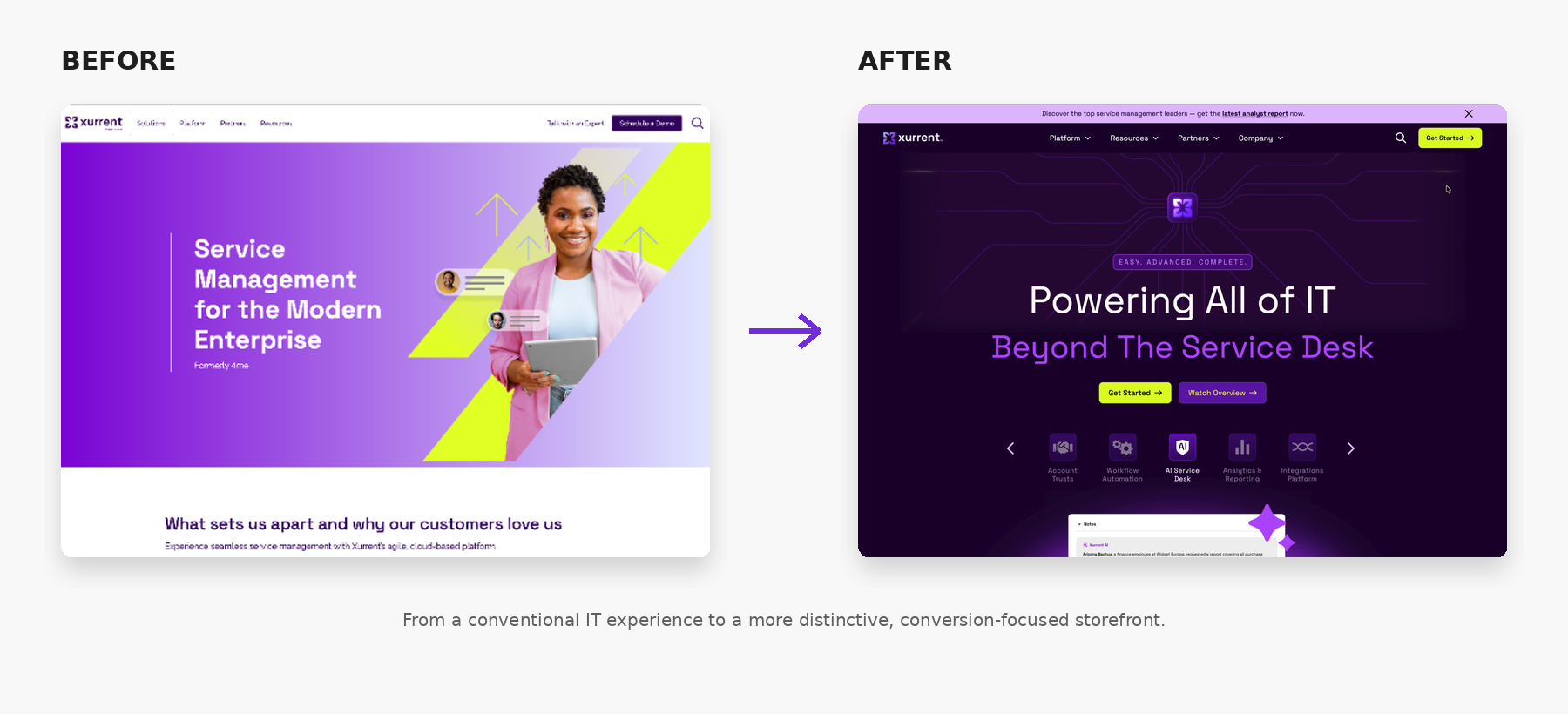
The existing site did the job of explaining the company, but it didn’t create much distinction. More importantly, it wasn’t designed as a true commercial storefront. Key messages, proof and conversion paths weren’t working together to move visitors toward action.
We needed the new site to do two things at once: make Xurrent unmistakable and make it easier for interest to become demand.
Make the brand feel as different as the name.
“Xurrent” is a play on current: movement, energy and momentum. We used that idea as inspiration for a visual system that could break away from the safe, cookie-cutter conventions of enterprise IT.
At the same time, we treated the website as part of the growth engine, not simply a brand destination. Every major page needed to answer the questions buyers had, establish credibility quickly and create a clear path to the next action.
The Idea
THE WORK.
Build a digital experience people would remember.
We moved away from the familiar look of enterprise IT and created a more energetic digital experience inspired by the idea of current and connectivity. Stronger contrast, motion and a more distinctive visual language helped Xurrent feel like a modern challenger rather than another service-management vendor.
Design the site around conversion.
We rebuilt the experience with CRO in mind, treating each page as part of a buyer journey rather than a collection of information.
Clarify the hierarchy. Put the most important value propositions, differentiation and proof closer to the top of the experience.
Create stronger paths to action. Give visitors clear next steps throughout the site rather than relying on a handful of isolated CTAs.
Use proof to reduce friction. Bring customer evidence, product advantages and credibility into the moments where buyers were making decisions.
Build for demand. Create a site structure that could support campaigns, content and paid acquisition rather than operating separately from the GTM motion.